
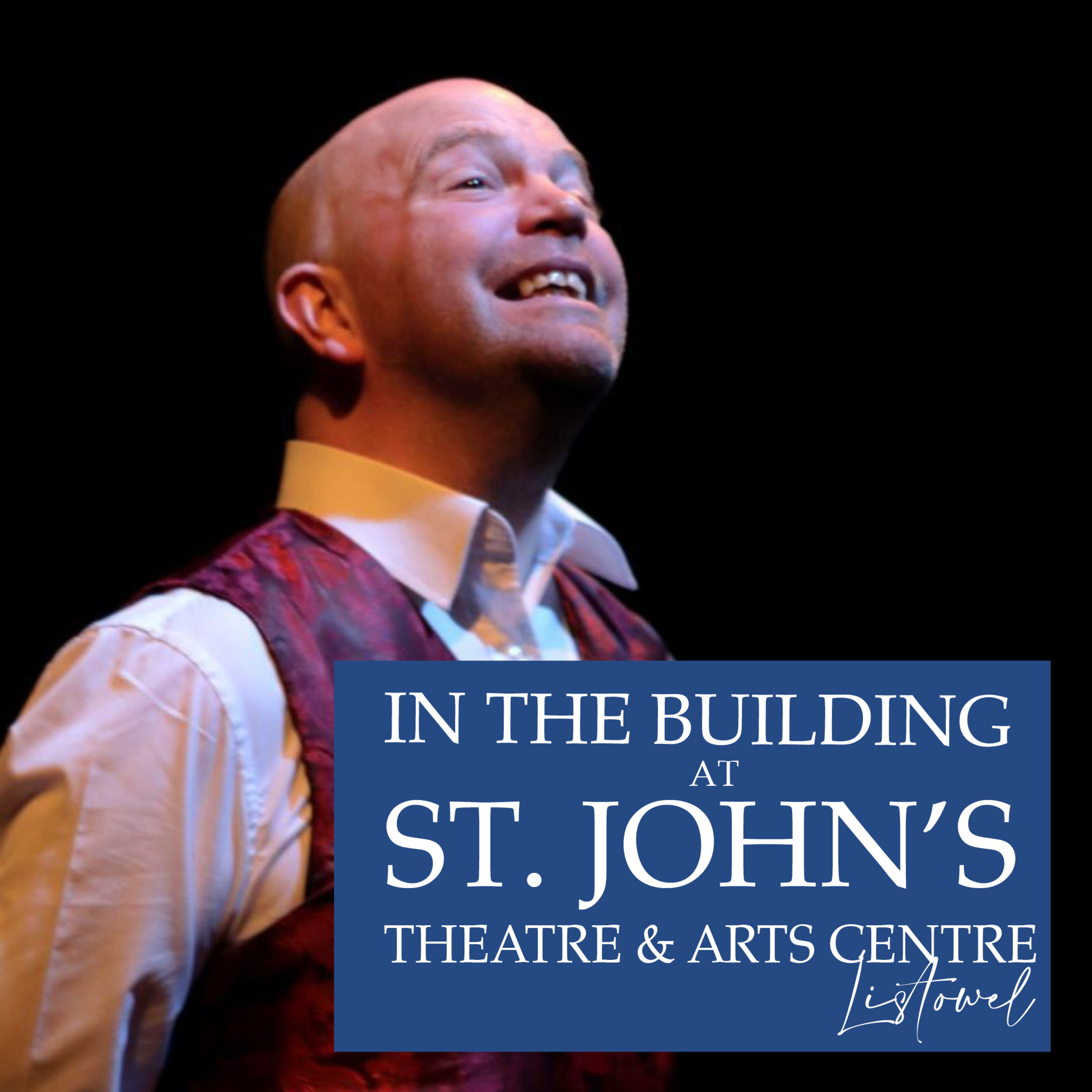
St. John's Theatre: In The Building
Martin Sullivan: The Reincarnation of Cornelius Agrippa

Martin Sullivan of Wilderland Productions joins Elizabeth Stack on In the Building, the St John’s Theatre & Arts Centre podcast, to discuss The Reincarnation of Cornelius Agrippa.
Inspired by Agrippa’s defence of a woman accused of witchcraft in Metz in 1519, the play opens a conversation about misogyny, persecution and the politics of fear - and why these stories still resonate today.
Martin shares how a footnote sparked years of research, the journey from academic study back to acting, and the challenges of writing, performing and touring a one-person show. Along the way, he and Elizabeth explore witch-trial history, the balance between historical sources and dramatic licence, and the creative choices that bring the story to the stage.
Read
Episode transcript
Elizabeth Stack: Welcome, everyone, to In the Building, St John's Theatre and Arts Centre's podcast. And I'm delighted to be joined today by Martin Sullivan, who is the founding member and chief bottle washer and artistic director of Wilderland Theatre Company Productions. And he's on tour at the moment around the country and coming to us here in St John's next week with his production of The Reincarnation of Cornelius Agrippa, Which is, well, we'll talk about the play in a minute, but of course, centres around a witch trial and the only time, in fact, that a lawyer advocated successfully for a woman who was accused of witchcraft. And so very good timing around Halloween, of course, Martin, to be doing this play. But there is more to it than just witchcraft and the Inquisition and the horrors of, you know, the Middle Ages in Europe.
Martin Sullivan: Yeah, it's what you call it, well, it's centred around that trial. It was 1519 in the city of Metz in France. It basically, the way, when I was sitting down to do, to do, to write it, one of the first questions I asked myself, how do I write about misogyny being a man? And how do I do it without sounding like a bearded hipster with something to hide or something, you know? So it was basically just dealing with misogyny as a form of political hatred, you know, a politics of hate. And like other politics of hate, it relies on other forms as well. So it's more or less, it's an exercise in intersectionality where misogyny might intersect with class, with race, so on and so forth. Almost like, and the kind of, the story plays out like that. Like, you have the run-up to the trial itself, you have the trial itself in the first act. The second act then deals with the consequences for Agrippa and those around him. And the play takes place in the present, and he's looking back. He's someone who says he's the reincarnation of Cornelius Agrippa. There is a reason why he comes back, or why he has to come back, and that's found out by the end. And I can't tell you, because that's a spoiler. So there you go.
Elizabeth Stack: Well, and I saw you were donating, or maybe the play originally came out of the Ukrainian issue, That you had donated some money to that cause. So, you know, obviously you're seeing themes repeated of persecution and immigration and, you know, Capitalism and misogyny throughout history. And this is kind of what drew you to it, maybe?
Martin Sullivan: Yeah, there's a bit of that. I mean, it did. When you talk about reincarnation, things occurring again and again. I suppose that's the obvious, you know, allegory or however you describe it, you know, the obvious parallel, you know. I didn't want it to be that obvious, but it was only afterwards there - all right, fair enough, if someone described it like that, I'll go with that. With Ukraine, to be honest, is, I'm just doing the fundraiser tonight now, up in Dublin. It didn't actually occur to me, but yeah, Ukrainian history itself has a lot of that as well. Like, I mean, God, in terms of misogyny, persecution, so on and so forth. And just all over European history, really. I mean, and it's kind of, one of the challenges was to get away from stereotypes and, like, simple reductions and so on and so forth. Like, power politics came into play in areas like, you know. There's some, for example, there's some areas in Germany where it was actually the majority of males that were killed, for example, as witches. But down, just down to the politics of the time. Down to the politics of the time. So it's kind of, you know, it's just trying to paint a fuller picture and so on and so forth, you know, but misogyny is, of course, yeah, one of the main threads pushing through the whole thing.
Elizabeth Stack: I was fascinated with the witch trials when I was younger, you know, and well, right away Through, I'm a historian by training, although more modern, you know, I focused on immigration In the 19th and 20th century. But I did, you know, some work on these and it's fascinating. And I'm very good friends with one of the professors up in Ulster University who's working on the Islandmagee witches. And so, you know, what's fascinating to me as someone who lived in America for a while Too, the Salem Witch Trials, you know, which was both men and women, but it kind of centered Around, you know, actually post-traumatic stress, you know, with these Indian wars that They were having and then land, women who were on their own and had inherited land or could Control land were often targeted. And so you see, and of course, I have to say, a certain type of kind of Protestant fundamentalist. So Catholics don't really, in Ireland at least, they do in, of course, France and Spain, the Catholics are involved in the Inquisition. But here in Ireland, we have a kind of an acceptance of folk wisdom and wise women and, You know, the veil between the two worlds being thin. And so we don't really have witch trials. Alice Kyteler, people will tell you, you know. But again, that was kind of property and maybe she killed the husbands, you know. And so except for Islandmagee, which again is this kind of Puritan strong - you know, a Puritan community. And I read this brilliant book called Damned Women by Elizabeth Reis. And she argues that a sort of the predestination, you know, beliefs in the Protestant faith made Women kind of, you know, be able to convince themselves that, oh, maybe I did contract with The devil, actually, or there's no proof in my good works. And Catholics have a kind of a more loosey-goosey relationship, you know, with God and blame And penance. And so I thought that was really fascinating that the mindset of the community could so Influence you, you know, that everyone knows there's a strange woman, you know, at the End of the village in Catholic towns. But we don't really mind. We're a little bit scared of her maybe, you know. But we'll integrate her into the community, whereas they persecute them in other communities, You know.
Martin Sullivan: Yeah, that's, geez, that's, that was a bit of news to me. All right. I mean, it's what you call it. When you mentioned land as well, very much so. I mean, in this particular case, yeah, land was involved. And then there's just collaboration between church and state. There's all these kind of things going on. That's, you know, like, you're trying to, like, when you're writing, you're kind of in your head, you're like, please don't be like the Monty Python, you know, Spanish Inquisition sketch. No, don't be just trying to avoid that, you know. So you're just trying to think that when you look at it from that type of intersectionality type of perspective, it's, it's a much easier to keep everything grounded down with that type of detail, you know. So it doesn't go off into whatever Hammer Horror as such, you know. Not that - Hammer Horror is great, actually. But what you call it, you just want to, you want to tell something that's real, that felt real and just do justice to that particular story. Because I never came across mention of it before. I never came across it either on TV or film or in theatre. And how he'd done it was just, it took a while to look up. But when I found it, I was like, oh my God, that's a genius thing, you know.
Elizabeth Stack: Okay. So it was the Cornelius figure, obviously, that drew you in first, was it?
Martin Sullivan: Yeah, you know. It was, to be quite honest, yeah. Because it was actually 2004 when I came across it. It was a footnote in the book. And it was pretty much, as I described, the only witch trial, da-da-da-da. And I was like, geez, I have to look that up, you know. I had to look, and I looked up the guy. He's what we'd call today a polymath. He'd done so many things, like, you know. And he wrote on, he wrote about women. I've heard him described as a type of proto-feminist. I wouldn't describe myself as a feminist, quite honestly. What do you call it? Feminist-friendly would be my description, you know. It's, what do you call it? But he wrote on, at a certain point, he wrote on women and the Bible and how the Bible could be used to argue just as easily that women are the nobler sex and so on and so forth.
Elizabeth Stack: Oh. That was a real great thing for that time, you know.
Martin Sullivan: It was. It was a switch, yeah. And students of his carried it forward and so on. So it was basically, wow, this is really interesting, you know. That was 2004. I ended up going back to college. I was actually, I might as well give a bit of a bio. I was doing theatre around Galway. That was around 2002 to 2005. I ended up going back to college doing the arts degree like everyone else. But college actually really suited me. So I ended up staying. At the same time, in the back of my head, it was always like, I will go back to acting and I will use that story. I made a PhD attempt at the start. It was 2014 when I came back. I fell ill, basically. Came back here and I thought to myself, what now? And it was like, yeah, it's time to write it. And ever since then - I got it written about 2015, I think it was. And since then, it was just trying to work out how to put it on. Because I had no experience in production, any of that side of things whatsoever, you know. It was always someone else, you know, they're around. And basically, I wanted it myself cost-wise and everything else. It just seemed a lot more straightforward. Because, you know, it does cost a bit. But at the same time, the one thing I had was time. So you kind of stretch it all out over time and pull it all together bit by bit by bit. Work out what you're going to do with it. Like, then COVID came along, then all kinds of little things. But, yeah, I managed to get it started. I think it's coming up to three years ago. It was actually Halloween in Dublin, I think it was, Smock Alley. And from there then, just kept going back to Galway and just all over the place. Donegal, Roscommon. God, I was in Limerick. Where was I last? Kilkenny as well. Alice Kyteler. I was down there.
Elizabeth Stack: Oh, good.
Martin Sullivan: So, yeah, basically, that's what I've been doing, like, you know, every month or so.
Elizabeth Stack: And is it resonating with audiences, do you think, this tale? I know there's more and you don't want to give away the end of the story, you know, about what happens to him. But there must be something about the story that's resonating with audiences, you know, maybe now more than even 10 years ago kind of thing, trying to get it off the ground.
Martin Sullivan: It's, yeah. Like, the reactions have been incredibly strong in cases. I think in a good way, not like people throwing stuff at me.
Elizabeth Stack: First time for everything.
Martin Sullivan: Yes. But, yeah, no one's really, I think people are actually a bit shocked by it, by the show itself. And I think in a good way. Because it's not what they expect in a lot of ways. I don't think they expected something that grounded or, you know, true to life and that, you know. And there is, there's other themes of it. There's other themes on it. I have to be careful of spoilers.
Elizabeth Stack: Spoilers.
Martin Sullivan: But I have to say, like, I'm really, really pleased with the reactions of it.
Elizabeth Stack: Okay, cool.
Martin Sullivan: So something's going right with it anyways. That's all I'll say right now.
Elizabeth Stack: And have you, I mean, obviously this is a huge project and you've been very successful with it nationally. Have you written other pieces or were you acting kind of all along in other people's productions as well? You know, since you finished college?
Martin Sullivan: It was just, I haven't done anything with anyone else. I haven't, to be honest now, what I've been doing is classes. I do classes with Mary Murray up in Dublin. The marvellous Mary Murray. I must say it was a fantastic help for this. That's, I've been doing classes there. It was after COVID, really, when I got my act together, if I’m honest. And started putting feet to ground and moving around, you know. Because the first time I tried doing a run of it, I realised, oh my God, I've forgotten how to act. You know, it was just like, it's all gone.
Elizabeth Stack: I know. And it's obviously a long thing to sustain on your own. You know, like there's two acts. Obviously you're carrying all the dialogue. If it's a trial, I can imagine, you know, it's higher energy that's needed.
Martin Sullivan: It is, yeah. It's a, well, it's a great workout. I will say that. What's quite, yeah, that's part of it too. I suppose that's part of the challenge as well, you know. Because the way it is for a high energy type of thing, you know, because there is a lot of story to get through. And you have to make sure that it's not just exposition, exposition, blah, blah, blah, blah, you know. That you have to have a good bit going on. Otherwise, everyone will fall asleep, you know. So, yeah, there's all kinds of, there's all kinds of little challenges like that. And you have to build it up scene by scene and so on and so forth. And even just working out how to present it. Like, during COVID, I was mucking around with masks and making masks and all that. And in the end, I had to pull the plug in that and say, no, that's not going to work, you know. So, I didn't know, like, you tried it and it didn't work and that's fine, you know.
Elizabeth Stack: But that's actually the creative process, you know, to go through those things. And even to think visually, like, will masks work or won't they work? And, I mean, that plague doctor's mask is so infamous and, like, instantly recognizable, you know. But you bring a whole thing of what you think it is, you know, when you see it. Honestly. I think that must have been very helpful.
Martin Sullivan: I had the plague, I have a plague mask. Somewhere around here still. Because I did get one for that. And I was like, can I get this in somewhere? Can I get this in somewhere? I was like, no, it's not going to work. I can't do it.
Elizabeth Stack: You’re self-censoring then, that’s great.
Martin Sullivan: You know, it's like, oh, it's great for Halloween and other things, you know. So, I have it there anyway.
Elizabeth Stack: It's great.
Martin Sullivan: But, yeah, part of it, well, and to be honest, part of it was pragmatic. Because it's just myself hauling everything around. And you're trying to cut down the weight, basically, on what you're taking about. So, like, the set is basically a table, two chairs. There's a little portable podium that I bring around. The rest then is costume and props. So, like, after this, I'm taking that podium, the big bag of things. I'm going up to Dublin with it. I start checking about half two. I do the show tonight. And what you call it, collapse the podium. I'll probably pick it up again the next day. But just come back down to Galway then with the rucksack and all that. And then pick up the podium later. You know?
Elizabeth Stack: That's amazing, though.
Martin Sullivan: But it's what's got, like, when I was doing it, I decided the one thing I really wanted to do was travel with it and go about with it. And also, it will fit in the plane, if need be.
Elizabeth Stack: Oh, great.
Martin Sullivan: So, we're, at some point, yeah, London and all that kind of, anywhere, an airport, really.
Elizabeth Stack: Absolutely. Well, and I think that's great, like, to strip the show kind of back, you know, and have it be about the story and the dialogue, you know.
Martin Sullivan: Yes.
Elizabeth Stack: Rather than the theatrics. Although I'm sure, you know, maybe, like, you've learned a lot about the, like, the technical and productive side of theatre, you know, because you're obviously creative. But then when you've got to try to, you know, like, physically, can I lift this stuff every day for, you know, however many weeks? That's, it's good that that has an impact, you know, on what you can do. But I think the austerity probably lends itself to the atmosphere, anyway, of the play, you know?
Martin Sullivan: Yes, that's true. It's like, the thing is, it's just, it's about sustainability, really. I mean, I know of fantastic productions, they put everything into it, they might even take off, they do put it on and go, wow, let's go to Edinburgh, you know? And they put it on in Edinburgh, and that's it, it fizzles out. And I knew after, certainly after so long, no, I want to do show after show after show after show after show, keep it going, keep it going. And really, it's that design that lets me do it, you know, relatively cheap transport, so on and so forth, use everything in-house. I mean, every show, I get a different table and chairs, and I'm like, you know, can I lift this chair? Can I do this with it? Can I do this, that, the other, you know? All stuff like that. It's a great excuse to travel to, you know?
Elizabeth Stack: Absolutely.
Martin Sullivan: Go to new places, you know?
Elizabeth Stack: Well, I'm excited to have you here. We are in an old Gothic, an 1819 church, used to be the Church of Ireland church here in town, so it's going to be the perfect setting and backdrop for you.
Martin Sullivan: Oh, I'd love that, yeah, definitely. I'd done it up in St. Nicholas's Church in Galway before, and I just absolutely loved it. I loved that, like, the set up, you know? I love history to begin with, you know? So, and so, a place with history like that, yeah, definitely. That's right up my alley.
Elizabeth Stack: And do you have another idea that you’re percolating, or are you just totally in the world of Cornelius Agrippa right now?
Martin Sullivan: I have something. I can't really, I don't, the only reason I want to say not to be all mysterious or ever, it's just that I learned the hard way before, you know? You only talk about it when you've got it in the bag, and you have it in the bag. I don't want to say, oh, yeah, I'm going to do this, and then six months later, it's like, you know? You feel like a fool, quite honestly. But yeah, there's something kicking around in my head. There's a number of things, you know?
Elizabeth Stack: Do you enjoy the process of writing, Martin? You know, is it something, because it's obviously so different, you know, like you probably have to isolate yourself in your way, whereas the acting is a very, I think, you know, the exchange of energy between an audience and a performer, you know, is something else. Do you enjoy having this idea coming and tapping into other people's voices, sort of?
Martin Sullivan: Well, part of the academic background, it's the research, really, where it gets done, I find. It could be different for other people, whatever. Especially if you're dealing with something historical and true to life, you know, true to life. You have to get details out. Now, with something like Agrippa from the 1500s, you've got a certain amount of latitude, because there's gaps. Obviously, there's gaps and so on, and you can do things, you know, like Mel Gibson and Braveheart.
Elizabeth Stack: Right.
Martin Sullivan: It's not like that, you know? But that's the most extreme example, you know? You can't take liberties. But the research part of it, it's the thing I'm looking at now, it's like, in particular, it is really, it can grind you. It can grind you down. But if you get through that process, and you start assembling scenes, and you have, the whole time you have it, have it like, you know, will this work here? Will this work here? Will I shove them around? And we have them on the page in sections, you know? It's like a row of buckets. Each scene is a bucket. You're filling up the buckets. Some buckets might be overflow. You don't need so much. Others might be empty. You're trying to fill it up. And then you're swapping around the buckets. And when you have it all lined up, then you just write through it and keep going with distilling, distilling, distilling. That part is fun.
Elizabeth Stack: I find, though, that the more research, the more effort you put into research, then the easier the rest of it comes then. Because you have mastery over your topic, essentially.
Martin Sullivan: Or as near as can be.
Elizabeth Stack: What do they say? That 99% perspiration and 1% inspiration, you know? So you're doing it behind the archives.
Martin Sullivan: I think it is pretty much like that. You know, once you have that command of it, you can play around with it a lot more then. And yeah, that is always fun. Once it gets to that, you know, that's where you know. And the other part of it is you find things that surprises and other types of things. Oh, I didn't know that, you know? It's like one of my old supervisors said before, you know your project is successful and you find something that surprises you. You know you're doing something right, you know? And yeah, and like, I found an old, the first assembly of Agrippa before. It was like multitudes of pages and whatever. And seeing where that's gotten to then over time, it's like, wow, that's unrecognizable. So, you know, yeah, it is fun like that, basically.
Elizabeth Stack: And with the Agrippa stuff, you know, it's interesting because I am not a medieval historian or, you know, an early modern. Were there, like, primary sources, court transcripts and things, or is it just kind of broader outlines so that you are free to sort of invent a little bit of what goes on? Like, obviously, you know, there's the court case, but, you know, did they transcribe everything sort of or just the highlights?
Martin Sullivan: I got the trial itself on what happened from a letter Agrippa wrote to a friend. It took ages to find that, to be honest with you. Lots of it then was, it was just general books at the time. This is now, this is 10 years ago, so I'm working off memory. It was books dealing both in witchcraft in general in Europe. You know, it was a question of scale, you know? You know, the broader picture, then you go into Europe, down to the country, so on and so forth. And then other people that were named and involved at the time and just the general scene. Thematically, then you had to go and pull in different things as well. So it was like, in terms of sources, I think some Agrippa's own writings were primary sources and basically gave direction. That letter was key, though. So I had an idea of the argument he used at one point, but I really wanted it, you know, nailed on, certified. And then once I found that letter, I was like, yeah, that's it. That's just brilliant, you know?
Elizabeth Stack: Great.
Martin Sullivan: I was able to take it from there then. There's parts of his story that I condensed certain parts. I've done other things with it, you know, as dramatic license as it were. But I think it does justice to it, basically, which is what I was looking for.
Elizabeth Stack: Well, we're looking forward to having you on Monday, the 9th of November. Tickets are available at stjohnstheatre.ie or call us 22566 here in Listowel. And Martin, enjoy your performance tonight in Dublin. Break a leg, and we’ll see you in about 10 days.
Martin Sullivan: Yep. Very much looking forward to it. Thank you very much.
Elizabeth Stack: Thank you. Not at all. Delighted to have you.
Martin Sullivan: Thank you.