
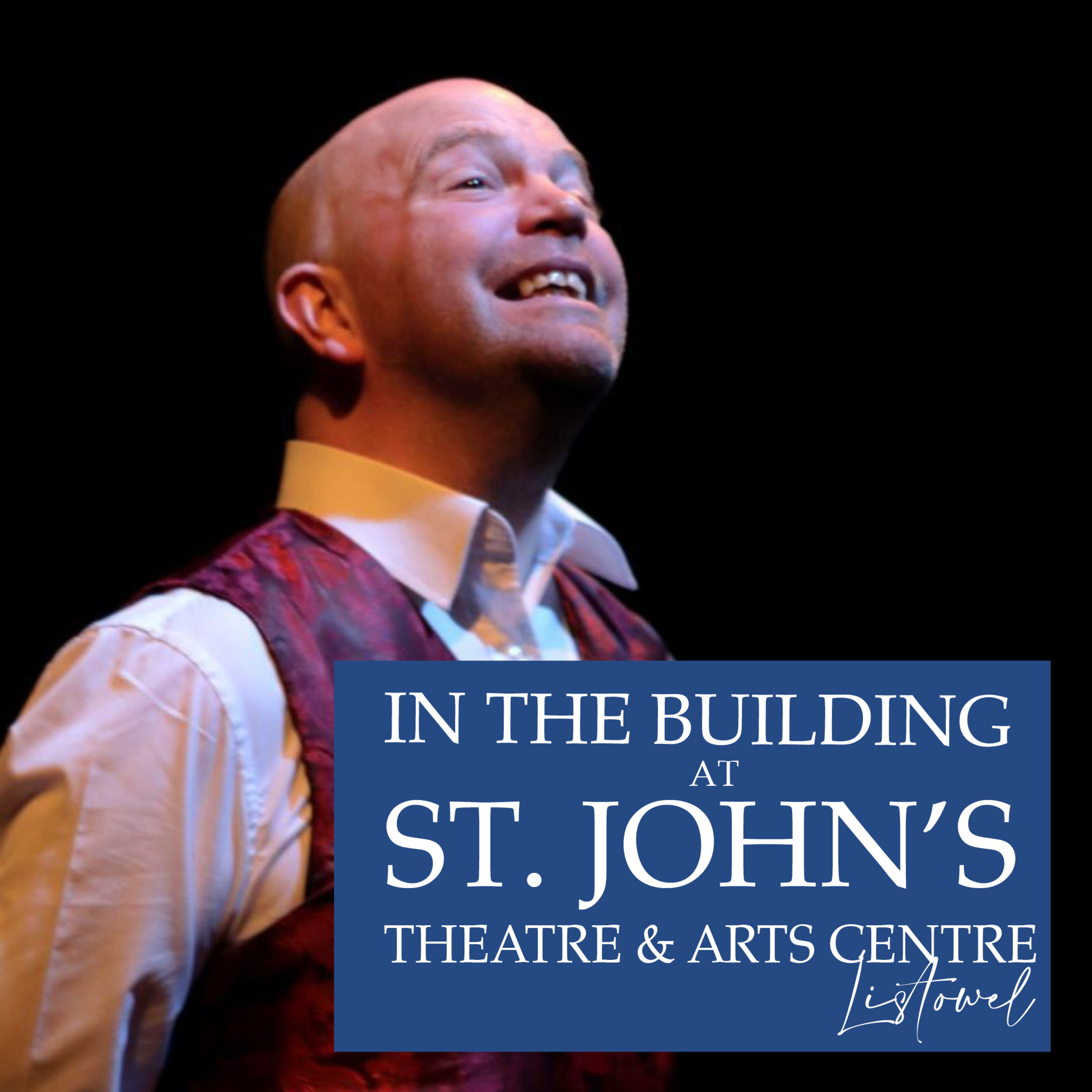
St. John's Theatre: In The Building
Visual Artist Donal Stack

Visual artist Donal Stack joins Elizabeth Stack on In the Building, the St John’s Theatre & Arts Centre podcast, for a conversation about art, inspiration and the world around us.
From AI and the changing role of the artist to music, politics and the power of speaking out, Donal reflects on how creativity responds to its time. He also shares the ideas behind his exhibition, Something for Everyone, revisiting childhood sketches, exploring portraiture and finding beauty in North Kerry’s working landscape.
Plus, a local mystery: where is North Kerry’s only freshwater lake?
Exhibition update: Something for Everyone runs until Tuesday 10 November 2026. Admission is free.
Read
Episode transcript
Elizabeth Stack: Okay, welcome. Donal, thanks so much for coming. This is our next edition of In the Building, the St John's Theatre and Art Centre podcast. And I'm delighted to introduce you as our very first visual artist that we've had. We talked about AI and, you know, whether art will survive it. And you do see it just as part of a natural evolution, that technology has kind of always changed art. And then you brought up an interesting point before we came on camera about art and the media and politics and propaganda, and how, you know, we were saying that Napoleon used art to kind of promote himself. Or, as you said, like the king: who knew what the king looked like, unless you saw it in a museum somewhere or a gallery, you know? I suppose the same was true even maybe of religion and things that art was used to teach the people, you know.
Donal Stack: Yeah, it was, it was illustrative, and it was used in the high crosses long ago in Ireland, and it was used in the caves, probably. And it was used to, art was sort of used as a kind of a tool for propaganda too, of course it was. It's all part of the whole, part of the whole record.
Elizabeth Stack: Right. And so then, I mean, we're getting deep into it now, but what is the responsibility of the artist then when you think about that? And particularly now, I suppose, where we're on this, you know, jumping off point of where maybe these deep fakes, as I say, and art. And maybe some people will argue there is a kind of an art making form in that, that if you can program a computer, you know, to do XYZ, is that not art in a way, you know.
Donal Stack: We'll find out.
Elizabeth Stack: We'll find out.
Donal Stack: Because the next generation will tell us. They'll figure it out themselves and they'll figure out whether it is artistic or not. I mean, it changes constantly.
Elizabeth Stack: Okay.
Donal Stack: I mean, you know, we'd always look back and say, how much art, how much art processes or art has been cancelled? Because it's considered now maybe not the thing that should be there now. It's constantly changing. So, when I say art, it could be anything. It could be films or sculptures have been torn down. Who are the artists who built those things or made those things? Like, it's just part of the whole kind of flux. And the artist, he doesn't have any responsibility. You only have to do what he’s told, really.
Elizabeth Stack: Okay. Isn't that interesting?
Donal Stack: Yeah, you know, you have a responsibility for yourself. You take the money and you have to do it. I mean, there are artists out there, because in more modern times, artists have the luxury where they could make statements. They could be individual and they could stand up for things. But that probably wasn't the way in the past. That's probably a more modern thing where artists can have a political input into how they look at the world and how they change the world.
Elizabeth Stack: Well, and we're seeing that play out at the moment with, for instance, Ed Sheeran and Macklemore. And it's, you know, that is.
Donal Stack: Maybe there should be more of it.
Elizabeth Stack: Well, you know, you could, I would definitely think, but I read Macklemore's statement, you know, and he said something about, like, to not get involved, like, is a choice, you know. And it is sort of taking your side, even though you're claiming neutrality, because to take a stance is so costly, you know.
Donal Stack: Yeah, it's a choice, yeah.
Elizabeth Stack: Like, they've lost gigs. And so, but I suppose, you know, we do maybe look to artists and creators sometimes, not to be our moral compass, but, you know, whether or not I think that you agree on the issue at hand. Like, I think Macklemore looks like a more principled person than Ed Sheeran at the moment.
Donal Stack: At the moment, yeah.
Elizabeth Stack: You know, and I'm not saying that either of them is right or wrong, but it is, that was a very interesting thing to watch play out all week, you know.
Donal Stack: You know, it's great. I think it's an education for people. People can look at this now and they can say, okay, right. And they're learning something. And whatever way you come down on it, it's not bland. It's not just, you know, I've always been critical of the last number of years in terms of the music businesses. There's no rebels. There's nobody out there doing anything. Everything's very safe. And I think it's great to see something.
Elizabeth Stack: I do too. But I suppose that in a way kind of goes back to what we're talking about with the oligarchs and technology. There's so much of their output can be controlled. Like if Spotify don't play or if Amazon, this, you know, one man can ring how many stadiums and get them to not take the concerts. Like, we've concentrated a lot of power, like, in, you know, [unclear phrase].
Donal Stack: And if you're not agreeing with them, they can do a lot of damage. Like, you know, I mean, art was always used to kind of sway people and direct people in certain ways and way of thinking right back to the middle ages. I mean, you can go on and on about that. But, you know, it's great to see people kind of maybe making a stand and making some sort of a statement. I mean, there was a lot of it went on in the 60s with the anti-war movements and all that. But it kind of all phased it out too, didn't it?
Elizabeth Stack: Absolutely.
Donal Stack: It's difficult to keep it all going. And you'd wonder what all these wars going on now that there isn't a kind of a counterculture. There isn't a kind of an anti-war culture out there in terms of the music industry or art or books. It's not, people are a bit afraid of the whole thing.
Elizabeth Stack: I think so. Well, it's almost like it's gotten bigger than us. You know, like you would kind of get together in the seventies and march for women's rights, or whatever it was. But it seems so huge. It's so kind of politicized and militarized.
Donal Stack: Yeah.
Elizabeth Stack: And I do, like, you know, Jeanie Mac, on the Palestine issue, like people have been marching for two years. And there has been no movement, you know. Like it's amazing that I suppose people are at the stage where they think our dissent doesn't seem to shift the dial at all. You know, so why are we out marching?
Donal Stack: And did it really stop the Vietnam War? Did it really stop those? You don't know.
Elizabeth Stack: You don't know.
Donal Stack: It's like, yeah, it's very, it's very, it's very controlled, I think.
Elizabeth Stack: It is, I think so too.
Donal Stack: Yeah.
Elizabeth Stack: Which makes it, in one way of looking at it, it's more important than ever that artists and musicians speak out, you know.
Donal Stack: There's very few, very few of them do. Now you have Kneecap and all those people. But you know, funnily enough, this is interesting. Now, the first time I ever saw anybody with a Palestinian flag on stage, when all this kind of happened a number of years ago, was a little lesser known by more modern musicians or music fans now. But he was in a concert, let's look into this again now. He was in a concert in the States and he was on stage with his guitar and his guitar was, had the Palestinian flag on the guitar. And who was it? Eric Clapton.
Elizabeth Stack: Wow.
Donal Stack: Yeah. I just look back into that and see what his story was. Because I thought, when I saw it first, I went, oh, I don't know if you should be doing that, Eric. And now I'm thinking, Jesus, was he the first guy to do it?
Elizabeth Stack: Was he the first?
Donal Stack: Yeah, it's true. He came from the 60s and from that whole period in the late 60s.
Elizabeth Stack: Just that. No, it is interesting. And the voice, you know, to use the power, you know. So what do you think, then, the future of art, in terms of - you were saying kids have plenty of opportunities at school now in a way that you didn't, you know, back when you had to teach yourselves art?
Donal Stack: Yeah, literally. And I think the Irish government is doing a good job, too.
Elizabeth Stack: It's fantastic.
Donal Stack: Like, trying to get this living wage for artists and stuff, you know.
Elizabeth Stack: It is amazing, actually, as a country that we value our culture so much now, I suppose, you know, we've commodified and exported it. It is one of the biggest draws to Ireland, like, is, you know, the likes of Riverdance and these kinds of things. But I think it is great that a country has such appreciation for its culture and you hope it trickles down.
Donal Stack: You hope it trickles down. All boats rise, is what they say.
Elizabeth Stack: Yes.
Donal Stack: I think so, yeah. It will filter into everything. The way we think about stuff. And I think it's very important.
Elizabeth Stack: It is. And it can be quite healing for a nation, too. Absolutely. Because we were talking there about commemoration and stuff and, of course, we've just come out of our own decade of centenaries, you know. But, you know, we were saying that some of the art can be controversial. So, in America, of course, they're tearing down these statues, you know, because of Civil War and Jim Crow. So, there is, you know, the motives of people around public art and then, as you said, like, the artist just has, to do his job, you know, sometimes.
Donal Stack: He's got to do his job in lots of ways. Yeah, there's a lot of art filtering through now from, particularly in the arts and media and music and all of that.
Elizabeth Stack: And so, then we were saying your own inspiration for this exhibit is, it's coming from some of your older work, but also newly inspired kind of pieces by the North Kerry landscape, for instance, or figures that you've admired.
Donal Stack: Things I've always wanted to try.
Elizabeth Stack: Good.
Donal Stack: Yeah, yeah. Maybe not so much wanted to try. Things I've always done when I was younger.
Elizabeth Stack: Okay.
Donal Stack: But I wanted to go back to them.
Elizabeth Stack: Okay, good.
Donal Stack: So, like, I spent my entire school days in the back of the class, in the back of my copybook, drawing airplanes.
Elizabeth Stack: Wow.
Donal Stack: So, you know what, maybe I should go back to that.
Elizabeth Stack: Okay, good. And then the faces, you said, is that a relatively new departure?
Donal Stack: Well, I love graphics. I love modern graphics. I love comic art. I love all that stuff. And, but I never really participated in it. Or really tried it. So, I just looked at it. And I don't think I'm a good portrait painter. I don't think I'm good at capturing anything like that. So, I leave that to people who can do it. And the people who can do it are amazing. I just can't understand how they do it. And I watch Portrait Artist of the Year constantly. And I just, I'm just in awe. So, I just said, I'll try simply. I'll just do a bit. I'll just draw a bit. And I'll paint a little bit and see how it goes. So, that's it. It's just an effort or a trial.
Elizabeth Stack: Okay, good.
Donal Stack: Yeah. See how it goes.
Elizabeth Stack: And so then, we were talking about the North Kerry landscape. You know, that we don't, of course, have the beauty that South Kerry is famous for.
Donal Stack: No. It's in North Kerry. It's all in the detail. It's in how people have interacted with their landscape. It's about the buildings, the sheds, the fields, the commerce of it. Because it was a working landscape. And, you know, the big estates, they were very successful in the old days. And they changed the landscape. And the abbeys, because they were farmers too. Monks and the Franciscans and all these people going away back. They changed the landscape in this area. Because we're lucky, the land was good. So it doesn't have the sublime Turner, Constable type of dramatic landscapes that you have in more rugged parts of South Kerry. The lakes of Killarney and all that. But...
Elizabeth Stack: But.
Donal Stack: We do have a certain type of landscape.
Elizabeth Stack: We do have a certain type of landscape.
Donal Stack: And it's a pastoral landscape. And, of course, we have a great coastline.
Elizabeth Stack: Great coastline.
Donal Stack: Yeah. But we don't have the lakes and the mountains.
Elizabeth Stack: No.
Donal Stack: Well, we've got Stack's Mountain, of course. Oh, God, yeah.
Elizabeth Stack: Our own crowd.
Donal Stack: And Knockanure. And, yeah, they're high enough.
Elizabeth Stack: They're high.
Donal Stack: You know, you don't have to be too worried about the...
Elizabeth Stack: The altitude sickness.
Donal Stack: And, look, I was saying earlier, we have one lake in North Kerry. But I'll leave that up to the listeners to figure out where that is.
Elizabeth Stack: Where that is, exactly. A fresh water, you were saying.
Donal Stack: A fresh water lake in North Kerry. There's only one.
Elizabeth Stack: Okay, good.
Donal Stack: I could be corrected on that.
Elizabeth Stack: Okay, so call in to St. John's and tell us.
Donal Stack: Yeah, because there is one anyway.
Elizabeth Stack: So, if you want to find out where it is, come to the exhibition. Come to the exhibition, exactly.
Donal Stack: Yeah, yeah.
Elizabeth Stack: So, we'll be open around the 5th of October. And it'll run for a month. And it's called Something for Everyone. So, there is something for everyone in this exhibit. We're delighted. Donal is our first visual artist that we've interviewed for this podcast. So, I'm very excited to have your work displayed. And thank you for joining me here today in the building.
Donal Stack: Thank you very much. It's my pleasure. An absolute... Looking forward to the whole experience. And thank you very, very much.
Elizabeth Stack: Me too. Thank you. Take care.